Mechanical fault detection
The availability of the mechanical fault detection feature depends on the camera model.
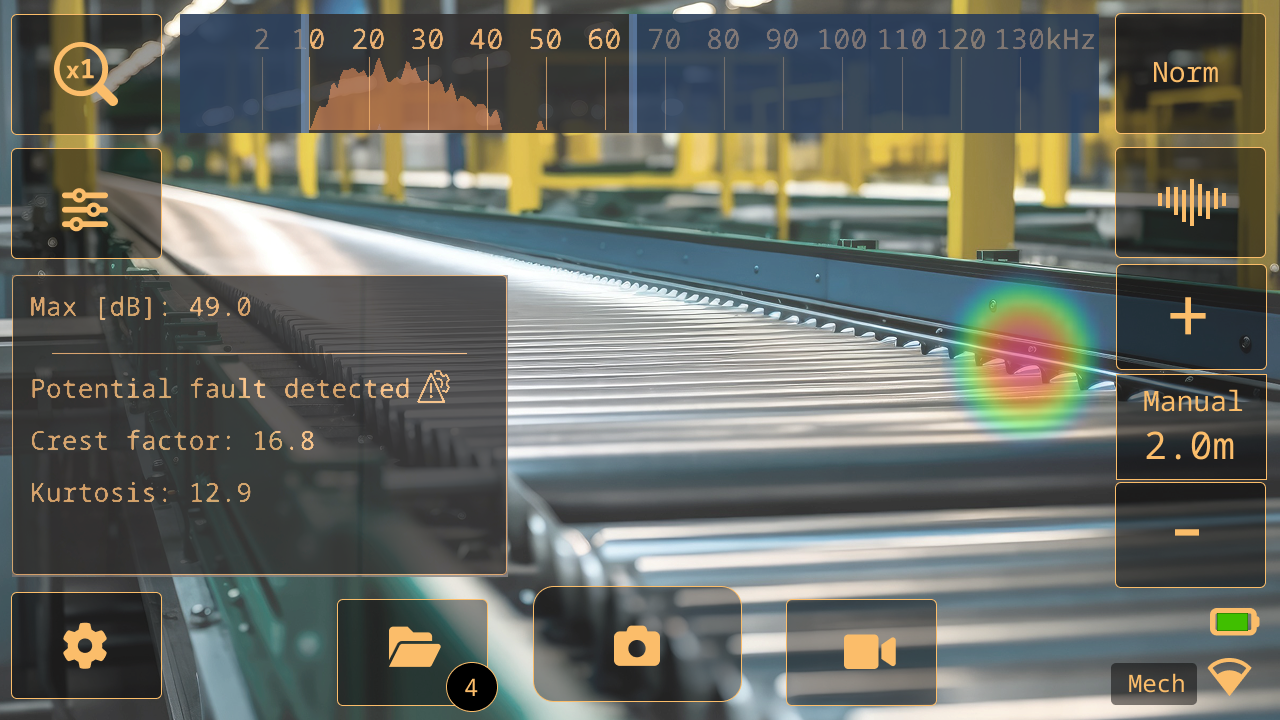
Constant wear and tear of key components in conveyor systems can lead to deterioration. Bearings that are in need of lubrication or are developing faults begin to emit excessive noise.
The camera can detect bearings that emit more noise than the other bearings in the vicinity, providing a precise non-contact means of identifying the bearings that are likely to be in bad condition.
To help identify faulty bearings, the camera provides four metrics: Mechanical Severity Indication (MSI), Sound Pressure Level (SPL), Crest factor, and Kurtosis.
Work flow
Make sure the Mechanical mode is selected.
Switch between the filters Norm, High, Ultr, or in some cases M.
Use the Multi-source mode first, which enables you to scan larger areas and find several sound sources at the same time.
To inspect interesting sound sources more closely, switch to Single-source mode.
When a potential mechanical fault is detected, the camera displays MSI: Potential Fault Detected. SPL, Kurtosis and crest factor are also shown in the analysis results on the screen.
The MSI provides a direct approach to identifying potential mechanical faults. Use additional mechanical analysis metrics like dB level, Crest factor, and Kurtosis to compare with similar components and track trends over time.
You can take snapshots and videos of the detected faults for further inspection and reporting in the FLIR Acoustic Camera Viewer or FLIR Thermal Studio.
Mechanical Severity Indication (MSI)
The Mechanical Severity Indication (MSI) analyses sound waves using an algorithm to detect signs of unevenness or friction in the movement of mechanical components, such as bearings. These are often an indication of developing faults or lack of lubrication.
How to use MSI:
Scan the mechanical equipment or component with the camera.
Avoid other noise sources as much as possible (Zoom and filters can help).
Once the acoustic map stabilizes, the device will indicate whether a potential mechanical failure is detected.
The MSI detects unevenness or friction in sounds, which may indicate faults in some components but could be normal in others. Always compare results with a similar component in good condition.
If multiple sound sources are present, the camera will analyze the loudest one. Ensure the sound source is an actual mechanical component.
Always consult an expert for maintenance decisions and use the MSI as a supplementary tool.
Mechanical fault analysis results
The camera displays the following analysis results in the Mechanical mode:
MSI
SPL
Crest factor
Kurtosis
SPL
Sound Pressure Level (SPL) is a measure of the strength of a sound.
When comparing the Sound Pressure Level (SPL) produced by different bearings, the bearings that are in bad condition will show a significantly higher SPL reading than bearings in good condition. As the condition gets worse, the SPL reading is likely to increase further.
Comparison should be made using the same filter and from a similar distance, otherwise the SPL values cannot be directly compared.
Crest factor
Crest factor is the ratio between the peak amplitude and the root mean square (RMS) value of a signal.
The Crest factor of the sound signal from healthy bearings is typically around 5. If the Crest factor is 6 or above, it is an indication that the bearing might need lubrication or is starting to develop faults.
As the faults develop further, the Crest factor will increase, but after a certain point, the Crest factor might actually begin to decrease. This means that if a bearing shows a very high SPL compared to healthy bearings, but the Crest factor is relatively low, the condition of the bearing might already be critical.
Kurtosis
Kurtosis is a measure of the distribution of the samples in the sound signal.
The camera shows Kurtosis as "excess" Kurtosis, meaning that a healthy bearing will show a Kurtosis around 0. A Kurtosis of approximately 2 or above is likely to indicate that the bearing condition is getting worse.
Guidelines
Different types of bearings running at different speeds behave differently, and as such no definite guidelines can be given that will cover all types of bearings. It is thus recommended to always compare the Crest factor, Kurtosis, and SPL of a bearing to healthy bearings of the same type, measured from a similar distance.
The following measures typically indicate potential issues with bearings:
Sound Level Pressure - very high, especially combined with a low Crest factor
Crest factor - 6 or above
Kurtosis - 2 or above